With 2 days in Paris, give the first day to the islands, the Left Bank and one big museum, and the second to the Eiffel Tower, the Marais and Montmartre at sunset. Grouping sights by area like this cuts out long metro rides, so you see more and walk less. Here is the day-by-day plan, with metro stops for each leg.
Quick answer
- Day 1: Notre-Dame and Sainte-Chapelle, the Latin Quarter, Luxembourg Gardens, Saint-Germain, then the Musée d’Orsay or the Louvre and an evening by the Seine.
- Day 2: Eiffel Tower and Trocadéro in the morning, the Arc de Triomphe, the Marais in the afternoon, and Montmartre for sunset.
- Book ahead: Eiffel Tower summit, Sainte-Chapelle, and the Louvre or Orsay. Timed slots sell out in busy months.
- Getting around: metro lines 1 and 4 cover most of this plan. Walk inside each area.
- Where to sleep: the Marais, Saint-Germain or the Latin Quarter keep you central for both days.
Is 2 days in Paris enough?
Two days is enough to see the city’s headline sights and get a feel for a few neighborhoods, but not enough to do everything.
You will have to choose. Pick one major museum, not three. Skip the long lines you can avoid by booking timed entry online. Accept that you are getting a first look, and plan to come back.
The plan below assumes a full two days on the ground. If you arrive at midday, start Day 1 at Sainte-Chapelle and drop the morning stops.
Before you go: what to book
- Eiffel Tower: book a timed ticket on the official site, especially if you want the summit.
- Sainte-Chapelle: book a timed entry, and allow extra time for the security check at the entrance.
- Louvre or Musée d’Orsay: book a time slot. The Louvre is usually closed on Tuesdays and the Orsay on Mondays, so check the official sites before you lock in your days.
- Notre-Dame: the cathedral reopened in December 2024 after the fire. Entry has been free, with optional reserved time slots to skip the wait. Check the cathedral’s official site for current rules.
2 days in Paris itinerary at a glance
Each day sticks to one side of the city, so most of your movement is on foot.
| Day | Base area | Highlights | Main metro lines |
|---|---|---|---|
| Day 1 morning | Île de la Cité, Latin Quarter | Notre-Dame, Sainte-Chapelle, Shakespeare and Company | Line 4 (Cité, Saint-Michel) |
| Day 1 afternoon | Saint-Germain, Left Bank | Luxembourg Gardens, cafés, Musée d’Orsay or the Louvre | Line 4, line 1, RER C |
| Day 1 evening | The Seine | Riverside walk or a boat cruise | On foot |
| Day 2 morning | 7th and 16th | Eiffel Tower, Trocadéro, Arc de Triomphe | Line 6, line 9, line 1 |
| Day 2 afternoon | Le Marais | Place des Vosges, side streets, museums | Line 1 (Saint-Paul) |
| Day 2 evening | Montmartre | Sacré-Cœur, Place du Tertre, sunset view | Line 2 (Anvers), line 12 (Abbesses) |
Day 1: Islands, the Left Bank and a big museum
Day 1 starts at the historic heart of Paris and works west along the Left Bank.
Morning: Notre-Dame and Sainte-Chapelle
Take line 4 to Cité. Start at Notre-Dame early, before the crowds build. The restored interior is bright and clean, and the square in front gives you the classic view of the west front.
Walk five minutes to Sainte-Chapelle, inside the Palais de la Cité. The upper chapel is almost all stained glass, and it is at its best on a sunny morning. Allow about an hour, including security.
Cross the Petit Pont to the Left Bank. Shakespeare and Company, the English-language bookshop, faces Notre-Dame across the river.
Late morning: the Latin Quarter and Luxembourg Gardens
Wander south through the Latin Quarter, past the Sorbonne and up to the Panthéon. The streets around Rue Mouffetard are good for a cheap lunch or picnic supplies.
Then walk west to the Luxembourg Gardens. Grab one of the green metal chairs by the central pond and rest your legs. It is one of the best free things in Paris.
Afternoon: Saint-Germain and a museum
Walk north into Saint-Germain-des-Prés for coffee near the old church of Saint-Germain-des-Prés. Then choose one museum.
- Musée d’Orsay if you want Impressionists in a manageable building. It sits in a former train station on the Left Bank, a short walk from Saint-Germain.
- The Louvre if you want the Mona Lisa and the scale of it all. Cross the Pont des Arts from the Left Bank. Pick two or three wings and ignore the rest.
Either one takes two to three hours if you stay focused.
Evening: the Seine
After the Louvre, walk through the Tuileries Garden toward Place de la Concorde. Or stay by the river and take a one-hour Seine boat cruise. Several companies leave from near the Pont Neuf and the Eiffel Tower. A cruise after dark is the easiest way to see the lit-up bridges and monuments without more walking.
Day 2: Eiffel Tower, the Marais and Montmartre
Day 2 starts in the west at the Eiffel Tower and ends in the north on the hill of Montmartre.
Morning: Eiffel Tower and Trocadéro
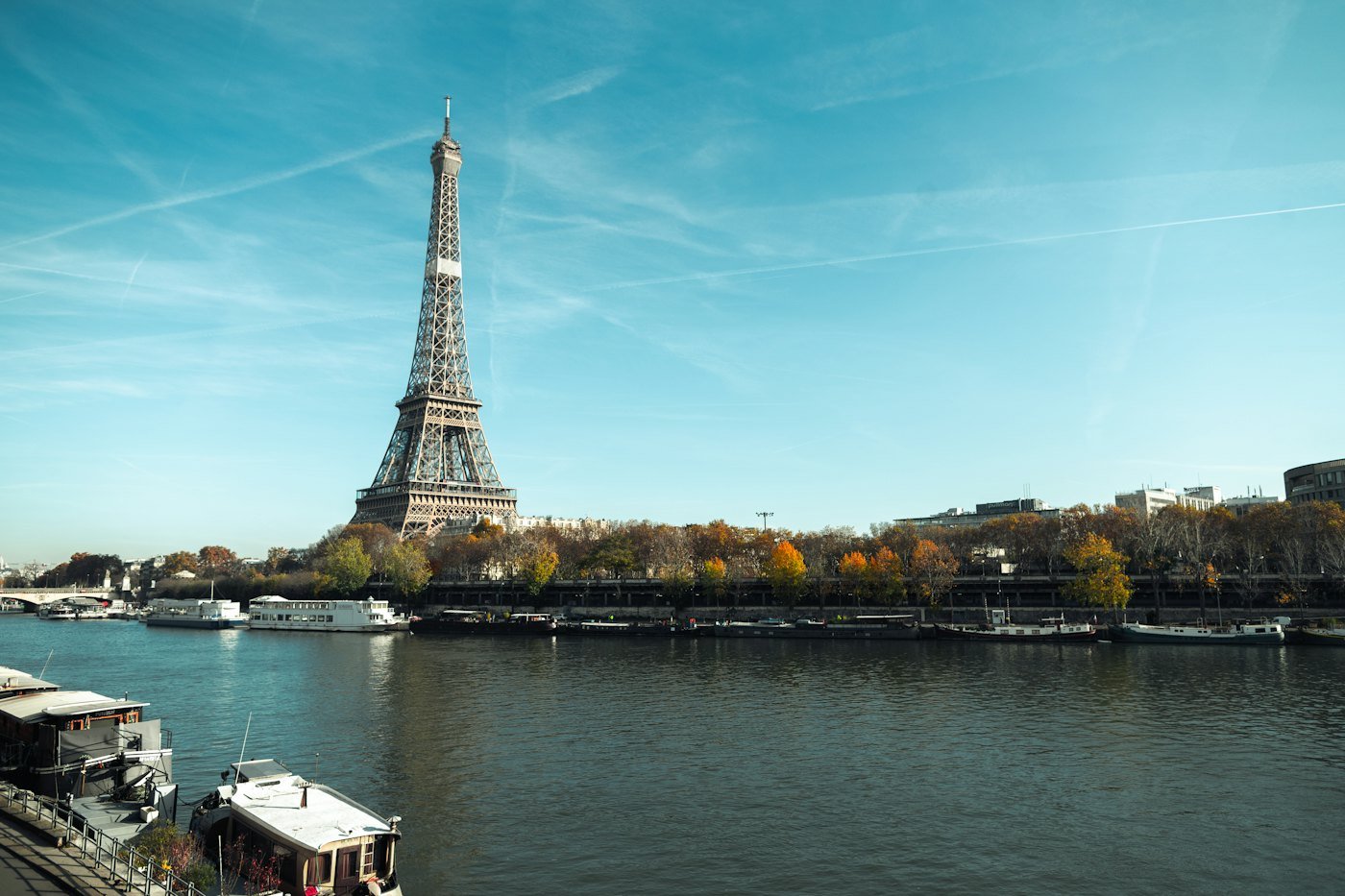
Arrive for your booked slot early in the day, when lines are shortest. The nearest stops are Bir-Hakeim (line 6) and Champ de Mars–Tour Eiffel (RER C). If you come in on line 6, look out the window as the train crosses the Seine on the Bir-Hakeim bridge. The tower view from the elevated tracks is one of the best in the city.
If you skip going up, the best ground-level views are from the Trocadéro across the river and from the Champ de Mars lawns.
Late morning: Arc de Triomphe and the Champs-Élysées
From Trocadéro, take line 6 to Charles de Gaulle–Étoile, or walk about 20 minutes up Avenue Kléber. The roof of the Arc de Triomphe looks straight down the Champs-Élysées and across to La Défense. Use the underground passage to reach it, never the roundabout.
Walk a stretch of the Champs-Élysées if you like, then get on line 1 heading east.
Afternoon: Le Marais
Take line 1 to Saint-Paul. The Marais is the best neighborhood in Paris to simply walk: old mansions, small galleries, falafel on Rue des Rosiers and shops on Rue Vieille du Temple.
Don’t miss the Place des Vosges, the oldest planned square in Paris, with its arcades and lime trees. If you want a museum, the Musée Carnavalet covers the history of Paris and the Musée Picasso is a few streets away. Check opening days on their official sites.
Evening: Montmartre at sunset
Head north to Montmartre. Take line 2 to Anvers and walk up, or ride the Montmartre funicular, which takes a standard metro ticket. Line 12 to Abbesses is the other option. That station is very deep, so take the elevator unless you want a long spiral staircase.
Watch the sunset from the steps below the Sacré-Cœur, then wander the lanes behind Place du Tertre. Eat dinner on the quieter streets downhill toward Abbesses rather than right on the square.
Watch your bag on the steps and at the bottom of the hill. Ignore anyone who tries to tie a string bracelet on your wrist.
Metro tips for a short Paris trip
The metro is the fastest way around Paris, and for this plan you only need a few lines.
- Line 1 runs east to west through the Marais (Saint-Paul), the Louvre, Concorde, the Champs-Élysées and Charles de Gaulle–Étoile. It is driverless and frequent.
- Line 4 runs north to south through Châtelet, Cité, Saint-Michel and Saint-Germain-des-Prés.
- Line 6 gets you to the Eiffel Tower and the Arc de Triomphe.
- Tickets: Paris has been replacing paper tickets with the Navigo Easy card and phone tickets. Buy a Navigo Easy at any station or use the official app. Check the RATP site for current fares and passes.
- Keep your ticket or card until you leave the station. Inspectors do check.
- Walking often wins. Many central stops are only a few minutes apart. If the trip is one or two stops, walk it.
Getting in from the airports
From Charles de Gaulle, the RER B train runs to Gare du Nord, Châtelet–Les Halles and Saint-Michel in roughly 35 to 50 minutes. From Orly, metro line 14 now runs straight into the center. A taxi is simpler with luggage, especially late at night.
Where to stay for 2 days in Paris
For a short trip, stay central so you are never more than a few stops from each day’s starting point.
The Marais puts you on line 1 and walking distance from Notre-Dame. Saint-Germain and the Latin Quarter suit Day 1 perfectly and have line 4 on the doorstep. Avoid basing yourself near the outer edge of the city to save money, since you lose too much time in transit on a two-day trip. Our guide to where to stay in Paris compares each arrondissement in detail.
Who this itinerary suits, and who should change it
This plan works for most first-timers, but adjust it if your travel style is different.
It suits
- First-time visitors who want the main landmarks plus two strong neighborhoods.
- Travelers who are comfortable walking 15,000 to 20,000 steps a day.
- Anyone adding Paris to a longer European trip.
Change it if
- You are an art lover. Swap the Arc de Triomphe for a second museum, like the Orangerie or the Rodin Museum.
- You are traveling with small kids. Cut one stop each half-day and add time in the Luxembourg Gardens or the Tuileries.
- You want Versailles. It takes most of a day, so it only fits if you drop Day 2’s plan or add a third day. Versailles is usually closed on Mondays.
Where to go after Paris
Paris is well connected by high-speed train. Amsterdam is roughly three and a half hours away from Gare du Nord, so it pairs naturally; see our list of the best things to do in Amsterdam. Barcelona is a longer ride, about six and a half hours by direct high-speed train from Gare de Lyon, and our guide to the best things to do in Barcelona has the plan for that leg. If you are heading south to Italy instead, start with our Italy itinerary.
For more ideas across the country, see our France travel guides, or browse everything in our Europe guides.
FAQ
Is 2 days in Paris enough for a first visit?
Yes, if you plan by area and book the big sights ahead. You will see the main landmarks and a couple of neighborhoods, but you will have to pick one major museum.
Should I visit the Louvre or the Musée d’Orsay with only 2 days?
Pick one. The Orsay is smaller and easier to enjoy in two hours, while the Louvre is the better choice if seeing its famous works matters more to you than a relaxed visit.
Do I need to book the Eiffel Tower in advance?
It is strongly recommended. Timed tickets, especially to the summit, often sell out in spring and summer, so book on the official site as soon as your dates are fixed.
Is the Paris Museum Pass worth it for 2 days?
Only if you plan to visit several paid sights, such as the Louvre, Orsay, Sainte-Chapelle and the Arc de Triomphe. You still need to reserve time slots at many museums, so check the pass rules first.
What is the best area to stay for 2 days in Paris?
The Marais, Saint-Germain and the Latin Quarter are the most convenient. All three are central, walkable and close to the metro lines this itinerary uses.
More Paris and Europe guides
- Where to Stay in Paris: the best arrondissements compared
- Paris travel guide
- Things to do in Amsterdam
- Where to stay in Barcelona
Continuing north by train to the Netherlands? Our guide to the best day trips from Amsterdam covers Haarlem, Utrecht, Delft and more.